APECS OCEANIA IN ANTARCTICA
We had nice weather on this weekend at Aurora Basin, blue sky with no wind.
Main and firn air drilling team are doing well with some minor problem.
Both team reached ~100 m depth. Saturday, our process team drilled 2 x 12 m shallow ice
core. Sunday was quite warm day that temperature goes up till -1.5 C. Inside process
tent temperature becomes positive degree that we have to stop working in there.
Otherwise all our precious ice cores will melt! We didn't expect this warm at ABN.
As we cannot work on our ice core, we decided enjoy this warm. Some people went to ski,
others went to walk on skiway, had a cup of tea under sunshine. When it’s cool down
again in late afternoon, we back to work. Process team drilled another 10 m of shallow
core, main drilling team reached 132 m, and firn air drilling team reached 104.5 m.
They also extracted air from two levels. They are finding that the bubbles are closing
more quickly than expected. We finished a day with nice dinner and few glasses of wine
in cosy kitchen tent. It was beautiful warm nice day.

Sunday, 5 January 2014

Friday, 3 January 2014
APECS OCEANIA IN ANTARCTICA
Finally, all of us made it into Aurora Basin on Christmas day. It was less than 2 hrs
flight with basler airplane. Field leader Sharon and Noel were waiting for us at skiway
and took us to the camp.
In the ABN camp, we have 1 kitchen/living tent, 2 ice core drilling tent, 1 ice core
In the ABN camp, we have 1 kitchen/living tent, 2 ice core drilling tent, 1 ice core
process tent, 1 power and equipment (PE) tent, 2 toilet tent, 1 med tent, and 18
sleeping tent. The camp is already in good shape that all tents are set up except
process tent which will be my working place. We have only one heater in our camp named
Toby. He is our best friend, he is hot and nice. He is always in the kitchen tent,
working hard to keep us warm. PE tent is important tent. There are 3 generators,
ice melter for making water, and shower! These generators provide all power in our
camp. We use electricity for drilling, processing, analysing ice core, communication,
cooking and making water. The shower is not really proper shower but we can use hot
water for washing ourselves occasionally which seldom happen.
After short break in cosy kitchen, we start setting up our ice core process tent to
After short break in cosy kitchen, we start setting up our ice core process tent to
complete our camp setting. It was windy day that difficult to put all cover on frames.
We took 2 days to set up our all process equipment.
Meanwhile, we had to postpone Christmas until the 26th Dec. That was quite experience
Meanwhile, we had to postpone Christmas until the 26th Dec. That was quite experience
having a Christmas in middle of nowhere and it was completely white Christmas! We had
nice dinner (Thank you, Jenny!), we had Santa Clause, we had gift, we had laugh, we had
very special good time.
Monday, 23 December 2013
APECS OCEANIA IN ANTARCTICA
Unfortunately, I’m still in Casey
station, waiting for my turn to get into the ABN. It’s been frustrated
week with waiting game for good weather to fly. This delay is all
because of the weather, we
cannot do anything. That is really frustrating.
Finally, first planes flew to the
ABN this morning with Mark, Simon, Malcolm and some important Cargos
and second flights with David, Jerome and Trevor just before lunch with
more Cargo. We allow to
sending only 6 people at first day due to considering cold temperature,
strong wind (-29°C with 15kts on Wed) and high altitude environment. These members are highly experienced crew to carry on science project;
drilling 3 ice cores and firn air sampling.
It was exciting moment when the
first crews left after 2.5 weeks waiting. Mark was surrounding by
several media crews and they were taking photo of him really close up. A
media crew put a mike on Mark
and following him with video. Put all personnel stuffs in bus, farewell
to rest of members, some video interview and photo session. And ready
to go.
Hopefully everything goes well
continuously, and rest of us can get into the field soon. I don’t need
Christmas present, so please give us few days of good weather! All my
fingers and toes are crossed!
Thursday, 12 December 2013
APECS OCEANIA IN ANTARCTICA
APECS OCEANIA IN ANTARCTICA
BY MANA INOUE
It’s been a week since we arrived in Casey station.
We are settling in
well and busy preparing for our field trip, sorting cargo, testing
equipment, safety briefing for working in high altitude and cold weather.
Malcolm, our field doctor, gave each of us a bag of medicine for the situation. We need to report our condition every day for first 10days when we get to the field for future reference. I hope We don’t need to use this much and adapt well in the special environment!
We are also helping other scientists out with their research by, shoveling snow, setting up instruments, and even doing house work, doing slushy in kitchen etc. Everybody down here are nice and are helping each other.
With our spare time, we went for a short walk to the wharf and Reeves Hill. I was expecting to see lots of penguins during this walk, but no luck. Well, we saw few penguins far far away. But it was too far that they just look like a few black beans in the snow.
My first Penguin was on Saturday night. After dinner, (people dressed up for Saturday dinner! This is special
dinner for the week.) we were in the living area, relaxing with few glass of
wine, when somebody looked outside the window and said ‘It’s a penguin over there!’ I ran back to my room and grab my jacket, got outside and there is a penguin wondering around nearby our heavy vehicles! He/she was just walking around the station for a while, then disappeared. Such an adorable little cutie animal!!
On Sunday with wonderful weather, field training officer James took us to Shirley Island. We walked on sea ice. Several little crack on sea ice reminds me of the possibility of danger and I think 'What if…. ' But the fear doesn’t last long with amazing view of ice/snow/blue sky/penguins/seals! Penguins are so friendly, of course, we are not supposed to get to close to them. But they are just coming up to us! A penguin came so close to us, and started walking on human track. He/she walk few step in front of me, looked back at me, walk few steps again, then look back me again. It’s like he/she is leading me to some wonderland! We then came to little
junction and he/she choose to go left, while I went right. He/she stop there for a
while, looking at me asking, why am I not following?!
A while later, he/she lost interested on me and just slide away.
We also saw few Weddell seals. They seldom move. They are just lying on ice. Sometime scratching their belly, rolling over to change sleeping position. We took a rest on top of the island, taking photo of everybody. Again, few penguins are come along to checking on us. They are really curious animals! That was amazing Sunday afternoon.
Highlight of this week was field training.
1st group of ABN on Casey station went to field training on Monday-Tuesday including Mark, Meredith, Jenny, Jerome, David, Trevor, Simon, Andrew, and me. First, we had a briefing.
We had to introduce ourselves and our role in the field, previous field and training experience, and something interesting about
ourselves that nobody in the team knows. It was a funny moment when telling our ‘secrets’ to each other. James said this is not boot camp, this is for working together as a team and for getting familiar with your gear and equipment.
Next, we moved to field shed. All gear we need such as boots, gloves, sleeping bags etc in this shed.
We got a sleeping bag, sleeping mat, throw bag, 2 pee bottles, few hand warmers in a back pack.
Get all gear ready, packed our lunch, and ready to go!
We got on 2 hagglund to the Casey skiway, 30 mins drive from Casey station. We set up the mess tent first and put out the table and
chairs. Looks like a comfy dining area little bit small for a total 10
ppl with big jackets.We then set up several polar pyramids as our sleeping tent, and for toilet.
Now some of you may be interested in how we go to the toilet in the field in Antarctica. As there are no toilets in Antarctica (except at field stations) we have to use a bucket. The bucket is lined with double black plastic rubbish bags, with a toilet seat attached, we sit down on the seat, a do our business. For boys, number 1's is much easier, just use a bottle and empty it into the big bin.For girls, however, things are little bit more complicated.We are issued special funnel for the small business. Use it to do in bottles as boys usually do, standing!!! Personally, I hate it. But when nature calls you have no choice.
Anyway, back to the field training. After we set up camp, we practice how to use our GPS. That is cool equipment. If we get lost in the middle of nowhere, it will lead us to the camp site. (previous setting required). We won’t get lost as long as the battery last! Viva technology!! We had a look skiway office, walked around airplane, took photos. Back to camp site, we practice how to use stove burner. This is also important to boil water/cook to keep warm. We are everyday working hard on first layer under skin! Keeping warm is crucial to survive in this environment.
Our wonderful chef, Jenny prepared our dinner before this training. We just need to warm up into boiled water. We got fried rice, pasta, beef stew, and lamb shank soup for dinner, several muffins, and chocolate cookies for extra. It’s really nice to have warm food on ice.
Then it’s bed time, even though the sun is still up and the sky is bright blue, it’s actually 10p.m. The weather was beautiful. It was -10 degrees, but didn’t feel like it. Because the weather was so nice, some people choose to sleep outside. For me, this is the 3rd time sleeping in tent in my life. I was afraid that I cannot sleep. But I slept very well the night.
Next morning, we woke up around 7a.m. After breakfast, we packed up tents, then practiced search and rescue techniques using our GPS and radio. We worked in pairs, with our commander telling us where to go through the radio, and follow the GPS. It was a little hard to walk around with big boots on snow, but it was good exercise.
Last training was blind walk. This is the training for in the case of zero visibility. 4-5 people connected in a line with a rope, eyes covered, and walked from shed to shed. We cannot see anything, just walk towards to next building. The surface wasn’t flat, so we had to walk slowly, and communicate with each other. We thought we are walking strait, but somehow we went to the left.
Hope we can do better in real situation. Well. Hope this kind of harsh situation won’t happen!
It was fun, useful training. Now we know how to build a polar pyramid, how to go to the toilet, how to sleep in cold camp. We are all ready to go to Aurora Basin!


Thursday, 5 December 2013
APECS OCEANIA IN ANTARCTICA
For the next 2 months APECS Oceania's Treasure Ms. Mana Inoue will participating in the Aurora Basin Ice Core drilling Project. During this time, Mana will be blogging from Antarctica to share her experiences with you. Below is her first blog.
My name is Mana Inoue. I am a PhD
student from Antarctic Climate Ecosystem & Cooperate Research Centre
(ACE CRC)/Institute for Marine and Antarctic Studies (IMAS), at the University
of Tasmania.
During my time in Antarctica, I will be participating in the Aurora Basin Ice Core drilling Project (http://www.antarctica.gov.au/science/climate-processes-and-change/antarctic-palaeoclimate/aurora-basin
(AAD site), http://tasabn.blogspot.com.au/ (Tas’s traverse blog)). This is my first trip to Antarctica. In this blog, I will talk about my experiences living in Antarctica and about life at Casey station and in the field.
Dec 3, 2013: Departure day
On December 3rd, we board our plane for Antarctica. Traveling by plane is much easier
and faster than by ship, but less sentimental.
Thankfully our flight was delayed by four hours which meant I could sleep a little longer. (Otherwise I have to be airport at 3:30 am!) I was super excited that I couldn’t sleep well though.
During our flight we had great weather, which allowed us to see seven mile beach, few islands, and beautiful southeast Tasmania. Water/tea/coffee and hot meal was served on the flight.
Our First Iceberg
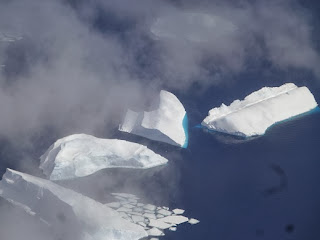
About 3 hours into the flight we saw our first iceberg. It was a tiny little white thing in ocean that I could barely recognise whether it was an iceberg or a patch of cloud. Then another one came up, little bigger. Then more and more and more, bigger and bigger and bigger. We saw beautiful blue ice and I think, I saw one ice berg just flipped. I think. I hit my forehead and nose on window glass many times.
Antarctica!
Then we our flight reached Antarctica! The pilot gave us a little tour flying over Casey station.White continent, sea ice, ice berg, ocean. It was awesome, amazing, beautiful view. It was just beautiful.
After ~5hr from departure, we landed on Wilkins runway. It was smooth landing and I finally, got to step onto Antarctica! It wasn’t cold at all with full survival gear on. Blue sky, no wind, strong Sun.
Sun is really strong here. One guy was walking around with sunscreen tube, asking people to put it on, and telling us that the sun is killing us here!
We get on the bus and drive to Casey station. A couple of photo stops, and after a 3 hr drive, we arrived at Casey station. Welcomed by Station leader, get some induction and settled in accommodation.
It was long exciting day. And now happy to get into the bed.


People in the field
Over 6 weeks some 24 scientists and support personnel will work at
the Aurora Basin ice core driling site. Two teams are planned, with
about 16 people in each team. The first team will work the first 3
weeks, before a partial change-over of some team members in the second 3
weeks. About 7 people are scheduled to work the full season. Read more
about the Aurora Basin project team in the following profiles.
- Nerilie Abram - driller and ice core chemist
- Chunlei An - driller
- Jenny Carlisle – chef
- Jerome Chappellaz - firn air drilling and pumping
- Mark Curran – science leader
- David Etheridge - firn air sampling
- Wang Feiteng - core analysis
- Mana Inoue - field assistant
- Sharon Labudda – field leader
- Olivia Maselli - core processor
- Joe McConnell - ice core handler
- Andrew Moy - drilling and core analysis
- Meredith Nation – project officer and core handler
- Noel Paten - AGSO and mechanic
- Christopher Plummer - ice core scraper
- Trevor Popp - driller
- Jason Roberts - driller
- Simon Sheldon - driller
- J.P. Steffensen - ice core documentation
- Tas van Ommen - driller
- Tessa Vance - drilling and processing
- Holly Winton - PhD student
Some Photos



Wednesday, 23 October 2013
‘Elite’ PhD scholarships within the broad area of “Humanities
Perspectives on the Antarctica”
Two ‘Elite’ PhD scholarships within the broad area of “Humanities Perspectives on the Antarctica” are currently being advertised at the University of Tasmania, with a deadline of 11 Nov. 2013.
For more information go to http://www.utas.edu.au/research/graduate-research/elite and look under ‘Humanities’. If you know of any potential candidates (the scholarships are limited to Australians or New Zealanders), please pass on the details. Interested students should get in touch with me in the first place.
Two ‘Elite’ PhD scholarships within the broad area of “Humanities Perspectives on the Antarctica” are currently being advertised at the University of Tasmania, with a deadline of 11 Nov. 2013.
For more information go to http://www.utas.edu.au/research/graduate-research/elite and look under ‘Humanities’. If you know of any potential candidates (the scholarships are limited to Australians or New Zealanders), please pass on the details. Interested students should get in touch with me in the first place.
Wednesday, 2 October 2013
APECS Oceania Executive Committee for 2013-2014
President - Molly Zhongnan Jia
Vice President (Aus) - Julie Janssens
Vice President (NZ) - Sira Engelbertz
Communication (Aus) - Meagan Dewar
Communication (NZ) - Lorna Little
Secretary - Sarah Ugalde
Treasurer - Mana Inoue
General Member - Holly Winton
General Member - Nita Smith
President - Molly Zhongnan Jia
Vice President (Aus) - Julie Janssens
Vice President (NZ) - Sira Engelbertz
Communication (Aus) - Meagan Dewar
Communication (NZ) - Lorna Little
Secretary - Sarah Ugalde
Treasurer - Mana Inoue
General Member - Holly Winton
General Member - Nita Smith
Subscribe to:
Posts (Atom)