Sunday, 3 August 2014

Congratulations to Monash University's Professor Steven Chown who has been awarded the Scientific Committee on Antarctic Research’s (SCAR) 2014 Medal for Excellence in Antarctic Research. 

 Over the past 20 years Professor Chown's work has provided considerable insight into the effects of climate change and biological invasions on Antarctic species and ecosystems. 
Professor Chown's research has is helping to ensure better conservation of the Antarctic and sub-Antarctic, through changes to regulation of the region. In addition, his contributions in this area, were recognised in 2009 when he was awarded the inaugural Martha T. Muse Prize for Science and Policy in Antarctica.

 http://monash.edu.au/news/show/monash-researcher-receives-antarctic-science-award

Tuesday, 11 March 2014


Great opportunity for anyone interested in science communication at Oceanians' doorstep:


In the scope of the upcoming 2014 SCAR Open Science Conference in August, APECS and the Polar Educators International (PEI) will be jointly running a full day workshop on Science Communication on Sunday 24 August at the University of Auckland in Auckland, New Zealand.

The workshop is for free and open to everyone - regardless whether you are attending the conference or not. However, the number of participants is limited to 60 people - first come, first serve.

You can register for the workshop either through the general conference registration (http://www.scar2014.com/registration/) or by filling out this online form (https://docs.google.com/forms/d/1Atlz9eY-fmF1rlKVaXyZDdnGIIjlrETJK6Ql8uRixN0/viewform).

More information is available at http://apecs.is/apecs-meetings-a-events/upcoming-events/scar-2014. If you have further questions, please contact Sira Engelbertz (sira.engelbertz@pg.canterbury.ac.nz) or info@apecs.is


We are looking forward to seeing you in Auckland!

Wednesday, 29 January 2014

APECS OCEANIA IN ANTARCTICA - FINAL BLOG
On Wednesday 15th of January most of the team left the Aurora Basin camp, with 11 of us heading back to Casey Station. We packed most of the scientific equipment before we left but there are plenty more things to pack, such as polar pyramid tents, the processing tent, and the kitchen tent. The four last people staying at the camp – Sharon, Mark, Jason and Bloo – will deal with this stuff.
It was an adventurous trip back to Casey. Eleven of us were spread across two flights in the Basler and the twin otter. I was in the twin otter. When we took off, I looked at the Aurora Basin camp from the window. Many memories crossed my mind. It was a fantastic three weeks. The flight was nice and warm. We saw a round rainbow with a plane shadow in its centre. The Basler flew with the boxed ice cores so they couldn’t turn on the heater. They had a freezing two hour flight.
We saw Casey station clearly from the air. But we couldn’t land on the skiway because of fog. This is Antarctica; how rapidly the weather changes, how different the weather is even at a close distance! So the twin otter landed on Mitchell Peninsula skiway, and the Basler landed on Wilkins runway.
There was a hagglund waiting for us. We jumped on it and half an hour later we were at Casey. We arrived at Casey at 11 pm and the chef kindly made us some sandwiches. We had a nice warm shower, a proper toilet, and a warm bed after a few weeks in field. Unfortunately for the Basler people, they took more time to land at Wilkins and they had to stay overnight.
Now I’m sitting in a corner in Casey station, thinking of the rest of the people at Aurora Basin; Sharon, Mark, Jason and Bloo. I hope they make it back by Australia day.
I’d like to say a big thank you to all members up in the field, Mark, Sharon, Tas, Noel, Malcolm, Simon, Trevor, Jerome, David, Chunlei, JP, Andrew, Meredith, Jenny, Tonny, Joe, Wang, Bloo, Jason, Olivia, Nerilie, Holly, Chris, Olivier and Tessa; all the people who supported us from Casey, Kingston, Hobart and all over the world; and all friends and families back home. Thank you very much for your support. Without your support, we couldn’t achieve our goals. I had an amazing, awesome, wonderful time at Aurora Basin. This experience is priceless and cannot be exchanged with anything else. And personally, a special thank you to Mark. I am very happy that I am your student.
  • 303 m four-inch main core (drilled by Simon and Trevor using the Danish Hans Tausen drill system, dry head to 132 m, reamed, wet drilling (Estisol) from 132 m; logged by Mark and Meredith, with a cameo appearance by Jen.
  • 116 m three-inch shallow core (drilled primarily by Tas, with a few metres by Mark and Meredith using the Australian Eclipse drill system, and some expert advice from Trevor; logged by Tas, David, Jerome, Chunlei, Mark, Meredith and Nerilie.
  • 103 m four-inch shallow core (drilled primarily by Olivier, with help from Jason and Nerilie, using a combination drill of French and Danish components; logged primarily by Nerilie. Chips from each drill run were collected for Chunlei.
  • Firn air pumping, sampling and insitu SARA (CH4) and LICOR (CO2) analysis, in the three inch eclipse borehole by David and Jerome.
  • Drilling three 10 m Kovacs ice cores (for overlap with the main cores). Captained by Joe with Wang and Mana.
  • 2.5 m snowpit dug under difficult weather conditions and sampled for 10 different parameters, led by Holly with the team Olivia, Chris and Mana. A second pit was dug to allow backlit stratigraphy (Meredith, Olivia, and Holly).
  • Automatic Weather Station, erected primarily by Meredith, with assistance from a number of people.
  • All sites were located using accurate GPS by Jason. GPS base station erected by Andrew and Tas.
  • Core processing equipment setup by JP, Joe, Wang and Mana (including ECM, horizontal bandsaw, vertical bandsaw, laminar flow bench).
  • Core density measured on main core by JP, and the processing team (Olivia, Mana, Chris and Holly), and on the four inch shallow core by Nerilie and Jason.
  • Cores processed to 80 m led by Olivia and her team Mana, Chris and Holly, including all 'pie' subsampling, ECM, stratigraphy, AAD trace chemistry sticks scrapped, melted and refrozen, and Picarro samples prepared for 20 cm resolution stable isotopes.
  • Picarro setup by Andrew, and samples analysed by Andrew, Holly and Olivia, with expert advice from Olivia and Trevor.
I’d like to finish my blog with some words from Jerome (actually from his wife). Even while he had a hard time dealing with the problem of his precious machine SARA, he never got upset. He was always calm and smiling and he told us these words, which made our day: 'Do your best and always remember that life is beautiful'.


Sunday, 19 January 2014

APECS OCEANIA IN ANTARCTICA

We are now close to finishing of the season (Jan 13). Kenobi the new heater is having a problem since being installed. He behaves well during the day time but not at night. Every morning, the kitchen tent is so cold and we find he is still sleeping. Waking him up becomes Bloo and Malcom's routine work in the morning.
We had a few days of strong wind and white out days, and now again we have clean beautiful blue skies. We saw a beautiful halo, rainbow and diamond dust at the same time. The environment here is so cold and harsh, but just awesome and amazingly beautiful at the same time. My vocabulary isn't good enough to explain this awesomeness.

Weather has been a problem for the flight since beginning. The first group of us got stuck in Casey for 3 weeks at the beginning of the season, and now Tessa has been stuck there for 10 days. Considering this lack of flight chance, station leader Sharon decided to start packing up and sending people back. Thus our process team finished our work on Wednesday and packed up our equipment on Thursday. We will fly back to Casey with the next available flight. We processed till 80 m depth of ice core. We had good team work.

While the process team are waiting for the flight, we worked on sampling snow pit, helping to set up Automatic Weather Station (AWS), and finding buried cargo and tents. All work mostly involves digging. Just digging. Keep digging. Digging digging digging. Finding buried cargo is actually fun. It's like treasure hunting!

Meanwhile, the main drilling team (Mark, Simon, Trevor and Meredith) reached 300 m, and French drilling team (Jason, Olivier and Nerilie) reached 100 m. We are now getting less ice core boxes, less drilling liquid and time is running out. On Sunday 12th January, considering our situation, Mark and Sharon decided to stop drilling. We got 303 m of ice core from main drill, 116 m of ice core from Eclipse drill, 103 m of ice core from French drill and 3 x 10 m of ice core from Kovacs drill. 
 APECS Oceania in Antarctica
  APECS Oceania in Antarctica
Setting up AWS
 Toby cleaning up
Snow pit sampling by Olivia 
Snow pit wall

Monday, 13 January 2014

APECS OCEANIA IN ANTARCTICA

Another week in Aurora Basin.
It was busy and quite a lot of changes in camp this week. It was not only a New Year,

but we had a changeover in our members, with nine people returning to Casey and six new members flying in to camp on December 30th. It was a sad moment saying goodbye to those leaving, with hugs, jokes, photos and promises shared. But it was exciting to have new people coming in. Our camp now became younger, and half of us are girls. We are waiting for our final member, Tessa, to join us and our camp population will be 16.

We have been having an unexpected problem with the temperature in our processing tent. Its not as cold as we expected - It has actually been too warm for us to work, with the temperature rising above 0 degrees during the day! Therefore the processing team Olivia, Chris, Holly and me are working evening till late night. Unfortunately that means we miss out on the chance to relax after dinner and join in the valuable sharing time with friends, but the work has to be done.


So far, on 5th Jan, we have drilled 193 m of the main core and 116 m using the Eclipse drill, processed 56 m of ice, scraped 27 m ice and analysed 16 m of ice for stable isotopes. We will begin drilling another core tomorrow!


I have one piece of sad news. Our precious, hottest friend Toby the heater passed away on the night of 4th Jan. He wasn't well for last few days but still working hard for us. The night, after dinner, his condition became unstable. Yet, he was waiting for us night workers to finish (Thank you, Mark and Meredith for fire watching!). When we came back to the kitchen tent at 1 a.m., he was in last stage. He was mumbling, puffing, suffering. Then suddenly, his little lid popped off and it was time to shut him down. This is how he died. We were sad and cold!

But next morning when I woke up, there was already new heater in the kitchen tent (Thank you Bloo!!). Toby 1 is now replaced by Kenobi (Jason 2014). So, we have a warm nice kitchen tent again.

 Bubbles trapped in ice core depth 130m
 Group photo Tas Camera tripot 1
  Group photo Tas Camera tripot 2
 Ice Core drill
 Joe trying to pull out ice core
 Mark logging ice core
 Process Tent
 Toby the heater

Sunday, 5 January 2014

APECS OCEANIA IN ANTARCTICA
We had nice weather on this weekend at Aurora Basin, blue sky with no wind.
Main and firn air drilling team are doing well with some minor problem. 

Both team reached ~100 m depth. Saturday, our process team drilled 2 x 12 m shallow ice
core. Sunday was quite warm day that temperature goes up till -1.5 C. Inside process 
tent temperature becomes positive degree that we have to stop working in there. 
Otherwise all our precious ice cores will melt! We didn't expect this warm at ABN. 
As we cannot work on our ice core, we decided enjoy this warm. Some people went to ski,
others went to walk on skiway, had a cup of tea under sunshine. When it’s cool down 
again in late afternoon, we back to work. Process team drilled another 10 m of shallow 
core, main drilling team reached 132 m, and firn air drilling team reached 104.5 m. 
They also extracted air from two levels. They are finding that the bubbles are closing 
more quickly than expected. We finished a day with nice dinner and few glasses of wine 
in cosy kitchen tent. It was beautiful warm nice day.

Friday, 3 January 2014

APECS OCEANIA IN ANTARCTICA

Finally, all of us made it into Aurora Basin on Christmas day. It was less than 2 hrs 
flight with basler airplane. Field leader Sharon and Noel were waiting for us at skiway 
and took us to the camp.
In the ABN camp, we have 1 kitchen/living tent, 2 ice core drilling tent, 1 ice core 
process tent, 1 power and equipment (PE) tent, 2 toilet tent, 1 med tent, and 18 
sleeping tent. The camp is already in good shape that all tents are set up except 
process tent which will be my working place. We have only one heater in our camp named 
Toby. He is our best friend, he is hot and nice. He is always in the kitchen tent, 
working hard to keep us warm. PE tent is important tent. There are 3 generators, 
ice melter for making water, and shower! These generators provide all power in our 
camp. We use electricity for drilling, processing, analysing ice core, communication,
cooking and making water. The shower is not really proper shower but we can use hot 
water for washing ourselves occasionally which seldom happen.
After short break in cosy kitchen, we start setting up our ice core process tent to 
complete our camp setting. It was windy day that difficult to put all cover on frames.
We took 2 days to set up our all process equipment.
Meanwhile, we had to postpone Christmas until the 26th Dec. That was quite experience 
having a Christmas in middle of nowhere and it was completely white Christmas! We had 
nice dinner (Thank you, Jenny!), we had Santa Clause, we had gift, we had laugh, we had
very special good time.

Monday, 23 December 2013

APECS OCEANIA IN ANTARCTICA

Unfortunately, I’m still in Casey station, waiting for my turn to get into the ABN. It’s been frustrated week with waiting game for good weather to fly. This delay is all because of the weather, we cannot do anything. That is really frustrating. 

Finally, first planes flew to the ABN this morning with Mark, Simon, Malcolm and some important Cargos and second flights with David, Jerome and Trevor just before lunch with more Cargo. We allow to sending only 6 people at first day due to considering cold temperature, strong wind (-29°C with 15kts on Wed) and high altitude environment. These members are highly experienced crew to carry on science project; drilling 3 ice cores and firn air sampling. 

It was exciting moment when the first crews left after 2.5 weeks waiting. Mark was surrounding by several media crews and they were taking photo of him really close up. A media crew put a mike on Mark and following him with video. Put all personnel stuffs in bus, farewell to rest of members, some video interview and photo session. And ready to go.

Hopefully everything goes well continuously, and rest of us can get into the field soon. I don’t need Christmas present, so please give us few days of good weather! All my fingers and toes are crossed!

Thursday, 12 December 2013

APECS OCEANIA IN ANTARCTICA

APECS OCEANIA IN ANTARCTICA 
BY MANA INOUE

It’s been a week since we arrived in Casey station.
We are settling in well and busy preparing for our field trip, sorting cargo, testing equipment, safety briefing for working in high altitude and cold weather. 
Malcolm, our field doctor, gave each of us a bag of medicine for the situation. We need to report our condition every day for first 10days when we get to the field for future reference. I hope We don’t need to use this much and adapt well in the special environment!

We are also helping other scientists out with their research by, shoveling snow, setting up instruments, and even doing house work, doing slushy in kitchen etc. Everybody down here are nice and are helping each other.

With our spare time, we went for a short walk to the wharf and Reeves Hill. I was expecting to see lots of penguins during this walk, but no luck. Well, we saw few penguins far far away. But it was too far that they just look like a few black beans in the snow.

My first Penguin was on Saturday night. After dinner, (people dressed up for Saturday dinner! This is special dinner for the week.) we were in the living area, relaxing with few glass of wine, when somebody looked outside the window and said ‘It’s a penguin over there!’ I ran back to my room and grab my jacket, got outside and there is a penguin wondering around nearby our heavy vehicles! He/she was just walking around the station for a while, then disappeared. Such an adorable little cutie animal!!

On Sunday with wonderful weather, field training officer James took us to Shirley Island. We walked on sea ice. Several little crack on sea ice reminds me of the possibility of danger and I think 'What if…. ' But the fear doesn’t last long with amazing view of ice/snow/blue sky/penguins/seals! Penguins are so friendly, of course, we are not supposed to get to close to them. But they are just coming up to us! A penguin came so close to us, and started walking on human track. He/she walk few step in front of me, looked back at me, walk few steps again, then look back me again. It’s like he/she is leading me to some wonderland! We then came to little junction and he/she choose to go left, while I went right. He/she stop there for a while, looking at me asking, why am I not following?!
A while later, he/she lost interested on me and just slide away.

We also saw few Weddell seals. They seldom move. They are just lying on ice. Sometime scratching their belly, rolling over to change sleeping position. We took a rest on top of the island, taking photo of everybody. Again, few penguins are come along to checking on us. They are really curious animals! That was amazing Sunday afternoon.

Highlight of this week was field training.
1st group of ABN on Casey station went to field training on Monday-Tuesday including Mark, Meredith, Jenny, Jerome, David, Trevor, Simon, Andrew, and me. First, we had a briefing.
We had to introduce ourselves and our role in the field, previous field and training experience, and something interesting about ourselves that nobody in the team knows. It was a funny moment when telling our ‘secrets’ to each other. James said this is not boot camp, this is for working together as a team and for getting familiar with your gear and equipment.

Next, we moved to field shed. All gear we need such as boots, gloves, sleeping bags etc in this shed.
We got a sleeping bag, sleeping mat, throw bag, 2 pee bottles, few hand warmers in a back pack.
Get all gear ready, packed our lunch, and ready to go!

We got on 2 hagglund to the Casey skiway, 30 mins drive from Casey station. We set up the mess tent first and put out the table and chairs. Looks like a comfy dining area little bit small for a total 10 ppl with big jackets.We then set up several polar pyramids as our sleeping tent, and for toilet.

Now some of you may be interested in how we go to the toilet in the field in Antarctica. As there are no toilets in Antarctica (except at field stations) we have to use a bucket. The bucket is lined with double black plastic rubbish bags, with a toilet seat attached, we sit down on the seat, a do our business. For boys, number 1's is much easier, just use a bottle and empty it into the big bin.For girls, however, things are little bit more complicated.We are issued special funnel for the small business. Use it to do in bottles as boys usually do, standing!!! Personally, I hate it. But when nature calls you have no choice.

Anyway, back to the field training. After we set up camp, we practice how to use our GPS. That is cool equipment. If we get lost in the middle of nowhere, it will lead us to the camp site. (previous setting required). We won’t get lost as long as the battery last! Viva technology!! We had a look skiway office, walked around airplane, took photos. Back to camp site, we practice how to use stove burner. This is also important to boil water/cook to keep warm. We are everyday working hard on first layer under skin! Keeping warm is crucial to survive in this environment.

Our wonderful chef, Jenny prepared our dinner before this training. We just need to warm up into boiled water. We got fried rice, pasta, beef stew, and lamb shank soup for dinner, several muffins, and chocolate cookies for extra. It’s really nice to have warm food on ice.

Then it’s bed time, even though the sun is still up and the sky is bright blue, it’s actually 10p.m. The weather was beautiful. It was -10 degrees, but didn’t feel like it. Because the weather was so nice, some people choose to sleep outside. For me, this is the 3rd time sleeping in tent in my life. I was afraid that I cannot sleep. But I slept very well the night.

Next morning, we woke up around 7a.m. After breakfast, we packed up tents, then practiced search and rescue techniques using our GPS and radio. We worked in pairs, with our commander telling us where to go through the radio, and follow the GPS. It was a little hard to walk around with big boots on snow, but it was good exercise.

Last  training was blind walk. This is the training for in the case of zero visibility. 4-5 people connected in a line with a rope, eyes covered, and walked from shed to shed. We cannot see anything, just walk towards to next building. The surface wasn’t flat, so we had to walk slowly, and communicate with each other. We thought we are walking strait, but somehow we went to the left.
Hope we can do better in real situation. Well. Hope this kind of harsh situation won’t happen!

It was fun, useful training. Now we know how to build a polar pyramid, how to go to the toilet, how to sleep in cold camp. We are all ready to go to Aurora Basin!


Thursday, 5 December 2013

APECS OCEANIA IN ANTARCTICA

For the next 2 months APECS Oceania's Treasure Ms. Mana Inoue will participating in the Aurora Basin Ice Core drilling Project. During this time, Mana will be blogging from Antarctica to share her experiences with you. Below is her first blog. 

My name is Mana Inoue. I am a PhD student from Antarctic Climate Ecosystem & Cooperate Research Centre (ACE CRC)/Institute for Marine and Antarctic Studies (IMAS), at the University of Tasmania.

During my time in Antarctica, I will be participating in the Aurora Basin Ice Core drilling Project (http://www.antarctica.gov.au/science/climate-processes-and-change/antarctic-palaeoclimate/aurora-basin (AAD site), http://tasabn.blogspot.com.au/ (Tas’s traverse blog)). This is my first trip to Antarctica. In this blog, I will talk about my experiences living in Antarctica and about life at Casey station and in the field.

Dec 3, 2013: Departure day
On December 3rd, we board our plane for Antarctica. Traveling by plane is much easier and faster than by ship, but less sentimental.  

Thankfully our flight was delayed by four hours which meant I could sleep a little longer.  (Otherwise I have to be airport at 3:30 am!) I was super excited that I couldn’t sleep well though.

During our flight we had great weather, which allowed us to see seven mile beach, few islands, and beautiful southeast Tasmania. Water/tea/coffee and hot meal was served on the flight.

Our First Iceberg
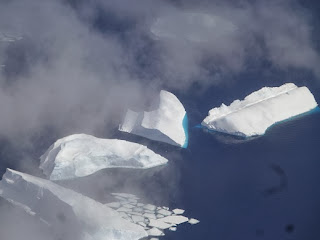
About 3 hours into the flight we saw our first iceberg. It was a tiny little white thing in ocean that I could barely recognise whether it was an iceberg or a patch of cloud. Then another one came up, little bigger. Then more and more and more, bigger and bigger and bigger. We saw beautiful blue ice and I think, I saw one ice berg just flipped. I think. I hit my forehead and nose on window glass many times. 

Antarctica!
Then we our flight reached Antarctica! The pilot gave us a little tour flying over Casey station.White continent, sea ice, ice berg, ocean. It was awesome, amazing, beautiful view. It was just beautiful.

After ~5hr from departure, we landed on Wilkins runway. It was smooth landing and I finally, got to step onto Antarctica! It wasn’t cold at all with full survival gear on. Blue sky, no wind, strong Sun.
Sun is really strong here. One guy was walking around with sunscreen tube, asking people to put it on, and telling us that the sun is killing us here!

We get on the bus and drive to Casey station. A couple of photo stops, and after a 3 hr drive, we arrived at Casey station. Welcomed by Station leader, get some induction and settled in accommodation.

It was long exciting day. And now happy to get into the bed.

People in the field

Over 6 weeks some 24 scientists and support personnel will work at the Aurora Basin ice core driling site. Two teams are planned, with about 16 people in each team. The first team will work the first 3 weeks, before a partial change-over of some team members in the second 3 weeks. About 7 people are scheduled to work the full season. Read more about the Aurora Basin project team in the following profiles.


Some Photos


Wednesday, 23 October 2013

 ‘Elite’ PhD scholarships within the broad area of “Humanities Perspectives on the Antarctica”

Two ‘Elite’ PhD scholarships within the broad area of “Humanities Perspectives on the Antarctica” are currently being advertised at the University of Tasmania, with a deadline of 11 Nov. 2013. 
For more information go to http://www.utas.edu.au/research/graduate-research/elite and look under ‘Humanities’. If you know of any potential candidates (the scholarships are limited to Australians or New Zealanders), please pass on the details. Interested students should get in touch with me in the first place.

Wednesday, 2 October 2013

APECS Oceania Executive Committee for 2013-2014

President - Molly Zhongnan Jia
Vice President (Aus) - Julie Janssens
Vice President (NZ) - Sira Engelbertz
Communication (Aus) - Meagan Dewar
Communication (NZ) - Lorna Little
Secretary - Sarah Ugalde
Treasurer - Mana Inoue
General Member - Holly Winton
General Member - Nita Smith

Wednesday, 25 September 2013

IGS2014 International Symposium on Sea Ice in a Changing Environment

The IGS2014 International Symposium on Sea Ice in a Changing Environment is happening in Hobart next March (http://seaice.acecrc.org.au/igs2014/).

The symposium local organising committee would like to encourage you to:
(1) Consider submitting an abstract for the conference (the deadline has been extended to 20th Sept 2013 and the Scientific Committee has indicated that a low number of submissions have been received from local students and ECRs).
 
(2) Consider volunteering to help with aspects of the conference itself. This might include helping to chair sessions, manning the registration desk, providing general info to international visitors or being involved with public events.
 
If you think you might be interested in number (2) then please get in touch with me, Petra Heil (Petra.Heil@utas.edu.au) or Molly Jia (Zhongnan.Jia@utas.edu.au), and we can provide you with more information. Volunteering at a conference like this would certainly be an excellent opportunity to make some great contacts for future work.

Wednesday, 18 September 2013

2013/2014 Enderby Scholarships

Enderby Trust invites applications for

the 2013/2014 Enderby Scholarships


Enderby Scholarships allow recipients to experience the Southern and Pacific Ocean in the same spirit of exploration and discovery
as the vessels of Enderby & Co.


Open to applicants aged 18 – 30 years, who would otherwise be unable to travel to the Southern Ocean.


Enderby Scholarship Background

Starting in 1830 the London based Enderby & Co outfitted vessels for commercial voyages of discovery, captains were expected to go above and beyond their normal duties in the services of discover & exploration. A series of remarkable voyages began with the 1830 departure of the Tula and the Lively, on this voyage Captain John Biscoe discovered land at 67ºS and named it Enderby Land. In 1838 John Balleny, sailing to the Southern Ocean on the Eliza Scott accompanied by the Sabrina discovered the Balleny Islands and Sabrina Land. A stalwart of Enderby & Co, Charles Enderby, was a founding member of the Royal Geographical Society and in 1841 he was admitted to the Royal Society of London for his “promotion of geographical discovery in the Antarctic regions”.

Enderby Trust works in conjunction with New Zealand’s premier expedition travel company, Heritage Expeditions, to offer scholarship positions aboard expeditions to the Subantarctic Islands and Antarctica aboard the Spirit of Enderby and Akademik Shokalskiy. (Refer to www.heritage-expeditions.com for vessel and expedition itinerary information.)

Enderby Trust was founded by the Russ Family knowing the opportunities for young people to visit these regions are limited but believing it is vitally important that young people experience this amazing region. The Trustee’s hope scholarship participants will share their experiences and enthusiasm with other people and grow the awareness of the Southern Ocean and Antarctica. Each expedition is accompanied by a team of naturalists and biologists to enhance the learning possibilities.


Application Process

In less than four hundred words you must persuade the trustees why you should receive a scholarship and how the experience will benefit both you and the region. The trustees encourage creativity & passion, so let this shine through in your application. Applications can be submitted in the medium that best suits you!

Applications should include:
  1. Full name and Date of Birth (proof of age may be required);
  2. Address including daytime and after hours telephone numbers;
  3. Scholarship applied for (Name and Departure Date);
  4. Submission expressing interest within the Southern Ocean (see above);
  5. Name and address of one referee;
  6. Declaration that you have sufficient funds to pay the contribution required.


Submit applications to:

The Trustees
Enderby Trust
P.O. Box 7228,
Christchurch 8240


Applicant Requirements

Successful applicants for the scholarships are expected to make a contribution to the expedition cost. This equates to 30% of the advertised cost of the expedition, Enderby Trust contributes the remaining 70% plus applicable government landing fees.

Successful applicants are required to submit a presentation in a mutually agreed style on a topic of their choice within three months of their travel. Recipients are reminded that a goal of the trust is too encourage greater interest in and understanding of the Southern Ocean, its landscapes, history and biological diversity. The submitted presentation should be in keeping with the aims and goals of the trust.


Closing dates for applications:

Friday 18 October 2013


Enderby Trust is offering scholarships on the following expeditions this season with Heritage Expeditions (full itineraries for these expeditions can be viewed on www.heritage-expeditions.com):


Birding Down Under
14 November – 2 December 2013
Bluff to Dunedin

Advertised price: US$10,500 pp.
Cost to successful applicant: US$3,150

Galapagos of the Southern Ocean
2 December – 14 December 2013
Dunedin to Bluff

Advertised price: US$5,600 pp.
Cost to successful applicant: US$1,680

Heritage Expeditions offers these two annual Southern Ocean expeditions to cater for those interested in birds and nature. Birding Down Under is arguably one of the greatest birding expeditions anywhere in the world and gives participants a unique opportunity to view numerous birds, in some cases including rare pelagic species and also endemic island species, it is the only Heritage Expeditions voyage that visits all of the Subantarctic Islands including the Chatham Islands. Galapagos of the Southern Ocean explores the three main island groups of Auckland, Macquarie and Campbell Islands and allows participants to experience the astounding biodiversity and importance of these islands as a wildlife refuge. Both of these expeditions will forever change your appreciation of the Southern Ocean and its wildlife. (The Trustees will also pay the applicable landing fees of US$650 pp)

In the Wake of Scott & Shackleton
17 January – 15 February 2014
Bluff to Bluff

Advertised price: US$18,700 pp.
Cost to successful applicant: US$5,610

Heritage Expeditions offer this voyage of discovery to the Ross Sea region of Antarctic every year which attracts those interested in nature and history. We break our journey to the ice at the Subantarctic Islands which are a part of the amazing and dynamic Southern Ocean ecosystem of which Antarctica is at the very heart. In the Ross Sea our passage passes icebergs, sea ice and glacial ice tongues, the journey is enriched by the wildlife we encounter and the historic sites we hope to see. This is one of the most remote and fascinating places in the world, a unique opportunity to experience nature on a scale so grand that there are no words to describe it, this expedition on Akademik Shokalskiy is truly a life changing experience. (The Trustees will also pay the applicable landing fees of US$750 pp)

New Zealand’s Remote Islands
9 – 19 March 2014
Bluff to Lyttelton

Advertised price: US$4,800 pp.
Cost to successful applicant: US$1,440

Expeditions to the Bounty and Antipodes Islands are almost unheard of, this season Heritage Expeditions offers this great opportunity to experience their unique natural and cultural history, plus take in the Chatham archipelago as well as the more accessible Chatham and Pitt Island. Our experienced on board lecture team share their knowledge and high conservation values for these islands making this a truly unique opportunity to not only see the islands but to learn from the experts. There are opportunities to observe many island endemic species including Antipodean Wandering Albatross, the very rare Magenta and Chatham Island Petrel and Erect-crested Penguins. This ‘one off’ expedition will enhance your understanding and appreciation of these remote island groups. (The Trustees will also pay the applicable landing fees of US$450 pp)

South Pacific Odyssey
2 April – 2 May 2014
Tauranga to Honiara, Solomon Islands

Advertised price: US$12,700 pp.
Cost to successful applicant: US$3,810

This expedition includes the rarely visited Kermadec Islands, Tonga (including the remote northern island of ‘Tin Can’ or Nuiafo’ou) the outer islands of Fiji, Vanuatu and the Solomon Islands. They boast lush tropical rainforest packed with many endemic birds and other wildlife while the seas surrounding the islands are some of the richest in the world in terms of marine diversity. This expedition caters for those interested in birds, cultural history and the rich marine life of these lesser known islands in the South Pacific Ocean. Although primarily about birds, this odyssey allows participants the opportunity to join our team of naturalists and experience the ecosystem of these Pacific and Melanesian islands on this Heritage Expeditions journey from Tauranga. (The Trustees will also pay the applicable landing fees of US$700 pp).